In het kort
Opent een externe website.

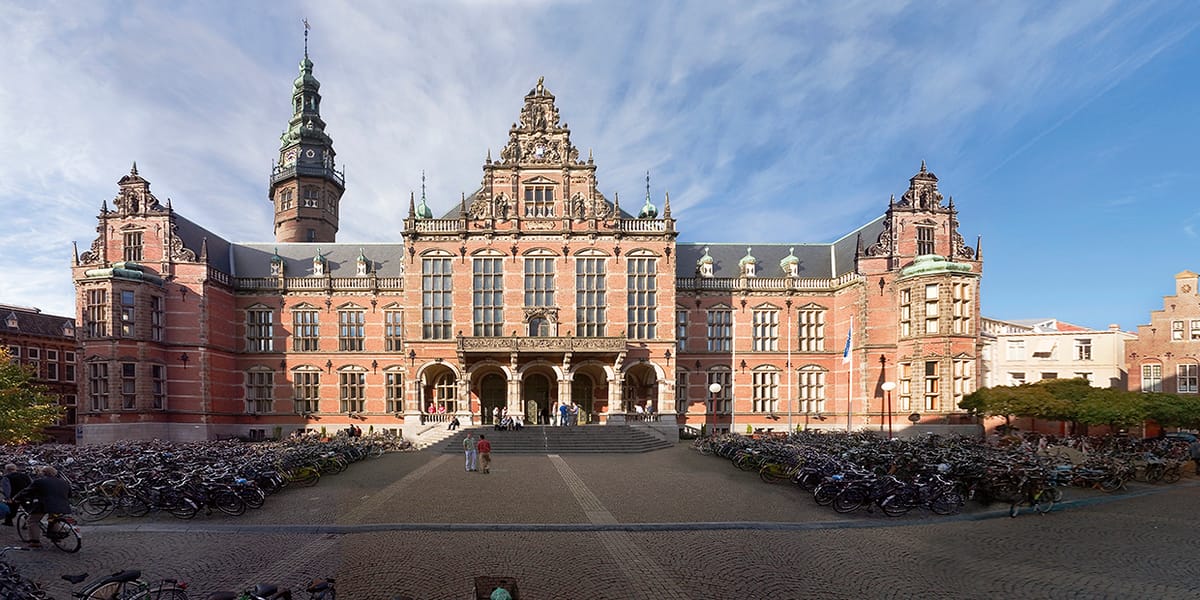
Rijksuniversiteit Groningen
Waar staat Rijksuniversiteit Groningen voor? Wat vinden ze belangrijk? Ontdek het hier.

For the National Growth Fund (NGF) project “Groeien met Groen Staal” (GGS), a PhD position for the period of 4 years is available in the context of modelling green steel mechanics from the atomic scale. In this project, the University of Groningen will investigate micro-scale and atomic-scale processes of dislocation-precipitate interactions for multi-component alloy systems that are relevant for the new green steels compositions, where precipitates can occur due to impurities and tramp elements. The goal of the project is to devise a multi-scale framework where atomic-scale mechanisms of precipitate shearing/looping are incorporated into micro-scale framework of dislocation-precipitate interactions. This model will enable to predict precipitate strengthening as a function of the green steel composition.
The successful candidate will be supervised by prof. dr. Francesco Maresca, chair of the Mechanics of Materials unit of the Engineering and Technology institute Groningen (ENTEG).
Where are you going to work?
What are you going to do?
Steel industry is increasingly faced with demands to reduce their CO2 emission and to increase scrap uptake during recycling. However, steel scrap is often contaminated with unwanted, i.e. tramp elements, because of the limits imposed by processes and recycling technologies. Consequently, some impurity elements will enter into the steel. In order to guarantee steel quality, it is essential to understand how these interact with the microstructure (including precipitates and dislocation networks) and properties of the steel. Atomistic modelling can provide crucial information regarding the intrinsic looping vs shearing mechanisms of precipitates, while microscale simulations enable to predict strengthening due to dislocation-precipitate interactions. A better understanding provides subsequent opportunities to mitigate the detrimental effects of impurities or potentially even exploit them to attain desired properties, e.g. by improving or developing new secondary steel production routes.
Who are you?
Talented, enthusiastic candidates with excellent analytical and communication skills are encouraged to apply. A MSc degree (or equivalent) in Mechanical Engineering, Civil (Structural) Engineering or a related discipline is required, with a strong background in solid mechanics. Experience with finite element implementation, coding, discrete dislocation mechanics, and atomistic modelling (molecular dynamics) are a plus. A strong motivation and interest in pursuing theoretical and computational research in mechanics of materials is needed.